The Hill

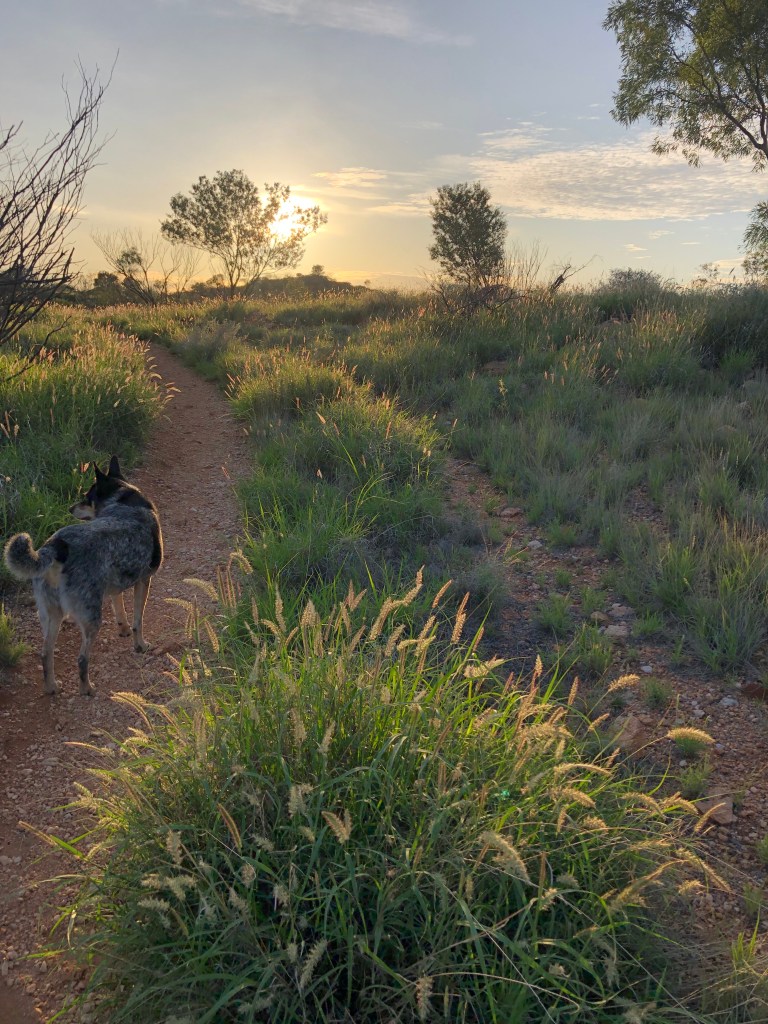
I’m in Alice Springs again, time out to write and look for family in the tangled recesses of the internet. House sitting and dog minding for friends of friends. It’s summer hot, and every morning we walk the hill. We – me and Jip – an aging blue heeler kelpie cross with a wicked sense of humour.

The hill is one of many stony outcrops on this eastern edge of town. Just one hill of many, crossed by multiple narrow tracks, many part of a ‘mountain’ bike network, graded and labelled with names and directional arrows. We walk the Eastside track and then branch onto the Inarlenge track, then scramble down through Henry’s ‘patch’ – one of several patches where a local is working to eradicate the invasive buffel grass – then along a sandy creek bed, passed Valmai’s ‘patch’ and then home.

It’s a crunchy, slippery walk. The rocks here dissolve into a quartz gravel that rolls under your boots. Jip skips down those bits, four legs make for greater stability than my two, while I creep, one foot, the next, stopping my slides on grassy clumps of buffel, the weed that dominates this landscape and, when alight, burns hot and dangerous.

The path is narrow, with dense buffel on either side, until we get to Henry’s patch. Not really a patch, more a small valley, enfolded between two high points. Henry has been weeding out the buffel for years here, digging it out, laying it flat, and then watching the landscape recover. No need to plant, the seeds of grasses, wattles, and more are there waiting. Here the path is edged with the tall stems of kangaroo grass, starting to form their distinctive ochre-coloured seed heads. It’s a joy to see them.

In the days before I arrived, warm wet air from the northern monsoon streamed across central Australia, dumping rain in Alice and across the Simpson desert, right through to northern Victoria. Rain, rain and more rain. Nourishing floods filling up the landscape with moisture, but hard for those who can’t move their homes out of the way. Our land tenure system fails when it floods, or burns. We are stuck in the way, evacuated out, but inevitably returning to that patch of ground called home, until the next time.

Arriving in Alice, there was water in the Todd River. A first for me after years of mainly winter visits. They say that January-February is when the Todd might flow, hooking into the monsoon, with water coming down at the hottest time of year.

Back to the buffel. Out in the Simpson earlier this year I learnt that it had been introduced for the pastoralists, one of the many ideas about how to improve the Australian landscape for farming. Buffel is a clumping grass, dense and domineering. It crowds out the native millet, toothbrush grass, feather grass and even the tall kangaroo grass. Where there is buffel there is little else.

Valmai is out tending her patch as we turn for home. She’s been out since first light. Her approach now is to spray the buffel, in part because weeding the big clumps out is getting too hard, and through observation she’s realized that the dead buffel holds the soil together, and then the ‘termites come to feast and after a couple of seasons only a skeleton remains. Her patch is measured in acres. It’s beautiful. A sandy creek beds weaves through, with tall grasses marking its course.  Her patch runs up and over a hill. Valmai points out the different grasses: several look to me like buffel – an oat grass I think she said. But her eyes are sharply attuned, and mid sentence she dives to pull out some young buffel plants, hanging them roots-up on a woody shrub – the Bradley method – or tossing them back onto the thick wall of buffel that marks the current edge of her patch.

Climb up onto the hill she suggests. Is there a path, I ask. You’ll find your way up, she says. The view is magnificent and you will see a lot from there.
Listen (the Call)

(to view the published format as part of Co-Lab 2021, click here)

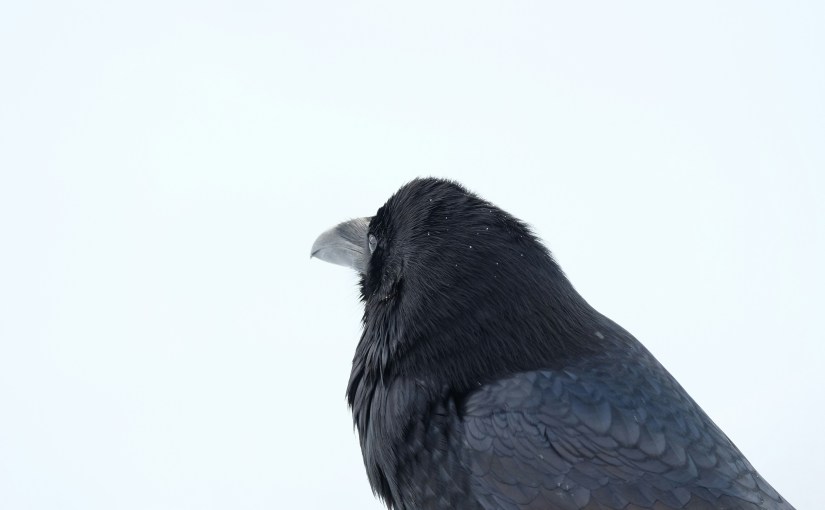
The calls are deafening. The birds have come, straight out of Hitchcock’s nightmare. One day just a few, then tens, then hundreds. Harsh-voiced calls, constant, surround-sound. Nothing can blot them out.

I open the door to a rush of wings. The occupying army takes flight, protesting the intrusion of human. It is their place now. I retreat and they resume their march back towards the house. So black. Piercing beak, sharp eye. I look out through the window – they stare back, chiding me for my indolence. The landscape is a moving carpet of ravens.

For months the cup moth caterpillars have munched through eucalypt leaves. A rain of green balls litters the ground: leaves into fertilizer. The trees are stripped, almost bare. And then the caterpillars fall. A rain of fat, stinging fat caterpillars, seeking the ground, a place to pupate.

Every underneath is filled with round pupating balls. Don’t stand still.

And then the ravens come. One and then a hundred. I hear them coming closer, working through the forest. And then they are here, surrounding the house. Every crevice probed, squabbled over, pupae cracked, eaten.

Excited, I post on facebook about this new phenomenon. I am told it is ancient. I am what is new.


Black as night
all colours in my darkness
white-eyed, far-seeing.

I fly.
My wings lift
on the earth’s breath.

Calling the
sky, the wind
my mate.

Echoing long
so all can hear
my warning.


Ravens are an ancient species. The blackest of birds, wholly black from feet to tongue, their feathers gleam green and purple.

Sociable, nomadic and flocking, huge gatherings of Little Ravens are known to congregate to exploit a sudden flush of food. Gleaners and reapers, not lamb killers, Little Ravens eat insects, spilt harvest grain, and carrion, walking with a swagger or hopping nimbly. Their baritone call is a guttural ark-ark-ark. Ravens mate for life.

A raven, once white and beloved of Apollo, was sent to spy on Apollo’s unfaithful lover. Returning, with this news, the raven was scorched black through Apollo’s fury.

Beware bad-tempered bosses.

Waa, the white raven, tricked the Karatgurk women – the seven sisters who held all the fire in the world on the top of their digging sticks. As the women beat off the snakes Waa had hidden, he grabbed the broken sticks but flew so fast, he was burnt into blackness.

Beware hoarding. Fly with care.

Back at the beginning of time, the snow-white raven discovered the Grey Eagle was keeping the sun, moon, fresh water and fire from people. Having hung the sun and moon in the sky, dropped the fresh water on the land, the raven flew on, holding the brand of fire in his bill. The smoke from the fire blew back over his white feathers and made them black. When his bill began to burn, he dropped the firebrand. It struck rocks and hid itself within them.

Beware: good deeds can change you forever.


Enli, impatient with the noise of humans, seeks to destroy the world with a flood.

Yaweh, furious at the corruption of man, seeks to flood the earth.

The sea, angry at the Kulin people, at their fighting, waste and neglect of Country, rises until it covers the plains.

Warned, Utnapishtim is instructed to build a boat so that life might survive.

Noah warned by Yaweh, is instructed to build an ark to preserve human and animal life.

Utnapishtim, loads all the living beings, his family, craftsmen, and seals the door. So fierce the storm, even the gods were afraid.

Noah sends his wife, children and friends on board, with both clean and unclean animals.

After six days and nights of storm and flood, Utnapishtim looks out on the flattened land. All the humans had returned to clay.

After 40 days and nights, the waters receding, the world is washed clean.

He sends a dove, but it returns. He sends a swallow, and it returns. He sends a raven. It did not circle back – finder of food.

An emissary is sent. A raven, black as coal, circles above until the waters are dried up from the earth.
A raven, feasting on the drowned. Symbol of evil or harbinger of survival?
God-like, hovering over the waters. The rebirthing the world.

Bunjil was entreated to stop the rising sea. But first Bunjil demanded the people change their ways. Then he raised his spear and commanded the sea to stop rising. Nerm remains flooded. 

As the seas rise again, who are our emissaries?


Sources:

Briggs, Carolyn, Bunjil: the time of chaos, https://cv.vic.gov.au/stories/aboriginal-culture/meerreeng-an-here-is-my-country/bunjil/; Clark, Ella E. 1953, Indian Legends of the Pacific Northwest, University of California Press; Epic of Gilamesh; Mudrooroo (1994). Aboriginal mythology: An A-Z spanning the history of the Australian Aboriginal people from the earliest legends to the present day. London: Thorsons. pp. 35–36.; The Kanatgurk and the Crow, from Australian Dreaming: 40,000 Years of Aboriginal History (1980) Comp. Jennifer Isaacs, Lansdowne Press, Sydney, NSW, pp. 107–108; The Raven and the Dove, Parshas Noach (https://torah.org/parsha/noach/); Walsh, Larry, Black Crow, https://cv.vic.gov.au/stories/aboriginal-culture/meerreeng-an-here-is-my-country/black-crow/

Crossing Big River

The river has been waiting for us. Deep, cold, fast.
Walking for days across the high plains, we know it is there,
waiting.

On Day 6, we will cross. It’s become ‘the river’.
Name forgotten. An imagined place, a trepidatious crossing,
a moment planned for and worried at.

The night before, the conversation is all river.
‘Thongs? Will I be able to cross in thongs?’ Or
‘Will the rocks be slippery?’ Our guide shrugs a grin.
‘How high will the water be?’ We all wonder the same.

—-

I was born south of another river, the Yarra Yarra, ever running,
water over the falls, beautiful but the wrong name.
Birrarung.

My creek, my play place, was named for John Gardiner,
nicknamed ‘overlander’ for bringing the cattle over to eat out
someone else’s Country.

I live in dry, gold-bearing ancient country.

My river now is the Loddon; she shrinks every summer
to a chain of disconnected pools. This Big River is wide and deep.
A real river. Dangerous.

—–

All day we’ve walked down Track 107, cut by Angus McMillan, once
called ‘Discoverer of Gippsland’, but no longer. Murderer, thief, false claimant.

Follower, never discoverer.

Jaitamatang guides led McMillan through their mountains, along their
pathways, filling his belly with their water, all the while he named and claimed
their land as a Scottish domain.

We walk the murderer’s path, cut from the bush
by McMillan facing poverty, condemned to labour, a path
from Big River to high country gold.

—-

There is a Big River. There at the end of our days. They
say to cross it is to be judged. To cross is to go from living to dead.
Styx is that river.

Oceanus, serpent-like god of the river that encircles
the world connecting earth and heaven, married his sister Tethys,
goddess of fresh water.

Together they birthed 3000 children, creating gods and goddesses
for all rivers, seas and oceans, so fertile that their lust
threatened to flood the world.

Styx, their oldest daughter, incarnate of hatred
her river is deep and treacherous. A coin on my tongue will
secure that crossing.

—-

The Big River. It does have a kind of name, an almost name. Big.
It wriggles down Spion Kopje, circles east, then south, trying to find a way
through its brother mountains.

This is Jaitmathang country, these high plains and plunging slopes.
Did no one listen to this river’s name? Lost now, forever.
Now just ‘big’, named on a day short of names?

Downstream it’s the Mitta Mitta River, the mida-modoenga,
river of reeds, in Dhudhuroa country. A true name revealed and
retained.

Big River I name you garrgatba, for your coldness, or perhaps
wanbayinagadha, Jaitmathang whisper, we are travelling,
going up the river to feast and dance.

—-

The river arrives in front of us, appearing out of the scrub.
We are here, it is here.

Our ford is where Dead Horse Creek merges into the river.
Our pack horses have already crossed safely.
Not a warning after all.

Pant are unzipped into shorts, or stripped off, revealing an
array of coloured undies above shivery white flesh. Boots off and laced to packs. 
No thongs.

I’m in my trusty walking sandals: they’ve walked me for days in the desert
A steadying stick, a branch from one of the many fire-killed snow gums
from the landscape of destruction higher up the mountains.

I step into the coldness, the wetness of it. Rocks shift underfoot, the water
deepens towards the middle, the bottom disappears below turbulent riffles:
Holding my breath.

—-

Here where the waters convergence.

There is a tug, a deep call
Jaitmathang, am I arriving or leaving? Big River hold me close.

Feet on Country

He said: ‘No feet on Country for decades now’. I hear him, an Elder of one of the Traditional Owner groups connected to Gariwerd, the soaring ranges European explorer Thomas Mitchell called the Grampians after a range in his native Scotland. What it means to have no feet on Country reverberates inside me, a hum of meanings and entanglements.

A desert of sand and dunes rolls out in front of me. The room disappears. We are walking Country: to see it, feel it, nurture it with our presence. We are in the footsteps of Wangkangurru people as they walked their desert, travelling between mikiri – water wells dug deep into the sand.

The desert fades. The room is full of voices, talking about what it means to look after Country. One man says: ‘the bush is a mess … too thick … the trees can’t breathe’, another that looking after Country means being ‘hands on’, caring for it with your own sweat work. It means being there, listen, hearing Country speak.

Mitchell’s wagon tracks cut deep into Country, the first of many shocks. Not feet, nor the caress of hands, of language and song.

That room, those voices seem like a lifetime ago: BC, before COVID, but it’s just a few months. My last desert walking was 2019, September, not quite a year. Afterwards I wrote about that trip into the eastern Simpson Desert, about meeting with Dr Karl Vernes, and about his search for what was once favoured Wangkangurru tucker – the Desert Rat Kangaroo. Now extinct or is it?

Here is a link to what I wrote: Gone to ground, or gone for good?

One more time with feeling

It was the last day and still they climbed. Nose to tail. Conquering. Ticking off the bucket list. Disrespecting.

The climb has closed, the desecration of Uluru ended.

Closing the climb has been debated for years, desired by the traditional owners but contested by tourism operators. Two years ago, after the proportion of visitors climbing fell below the trigger level for closure, the fate of the Climb was sealed.

At the end, they came in their thousands. Not to celebrate its closure, but to climb.

Back in 2001 Hilary du Cros and I gave a paper on two sacred places – Pashuputinah and Uluru – at the Australia ICOMOS Making Tracks conference in Alice Springs. In the paper we reflected that travelling to ‘Ayers Rock’ was like a secular pilgrimage, a process of paying respect in photographs or through the Climb, but visiting Uluru was to experience another place entirely. As our paper revealed, back then many tourism operators still called it ‘Ayers Rock’ and few promoted the ‘don’t climb’ message.

Responding to a place – and how culture shapes what and how we see place – motivates my work. Uluru has entranced me since my first visit in 2001, and Uluru has called me back many times.

Climbing Uluru, once a sacred journey became one framed by challenge – conquering a ‘mountain’. Climbing was how to engage with this place. What might it feel like to climb?

In 2018, after visiting again, I wrote about Uluru and the Climb: first as non-fiction (‘The Climb’) and then a fiction fantasy (‘The last climb at Ayers Rock’). I’m sharing them here, as part of my first blog post to celebrate the closure of the Climb.

Shifting into fiction moved the focus from my own experience. The climbers are lightly sketched, in a way suggesting that they are insubstantial compared to Uluru itself, and yet one of them has history here. And I wanted my sense of the spirit of Uluru to somehow overwhelm the characters – Bill and his family – and perhaps transform them. On a deeper personal level, why did I want Bill and his family to climb? And to become lost, engulfed and maybe transformed? There is something about the transformative nature of imagining being able to see the world through another’s eyes and culture. It is not an authentic ‘seeing’ as we can never be other than who we are. But sometimes a window opens, and for a moment our world is different: there are creation ancestors shaping the land, trees can fly, giant snakes can rebirth Uluru.